Phra Nakhon Si Ayutthaya

The Phra Nakhon Si Ayutthaya or Ayutthaya in short, is one of Thailand's historical and majestic highlights. Serving as the Thai capital for 417 years (1350 1767: Kingdom of Ayutthaya), it was once glorified as one of the biggest cities in Southeast Asia. During the 17th century, most foreign visitors to Ayutthaya, traders or diplomats alike, claimed Ayutthaya to be the most illustrious and glittering city that they had ever visited. The map of Ayutthaya published in 1691 by Simon de la Loubere in Du Royaume De Siam is proof of such recognition.
The Kingdom of Ayutthaya reached its apex in terms of sovereignty, military might, wealth, culture, and international commerce in the 16th century when the Kingdoms territory was extended far beyond present-day Laos, Cambodia, and Myanmar. Ayutthaya even had diplomatic relations with Louis XIV of France and was courted by Dutch, Portuguese, English, Chinese and Japanese merchants.
Visitors can explore and appreciate Thai history in Phra Nakhon Si Ayutthaya, which is situated only 86 kilometers north of Bangkok. Visitors to Ayutthaya can marvel at its grandeur reflected through numerous magnificent structures and ruins concentrated in and around the city island surrounded by Maenam Chao Phraya, Maenam Pa Sak and Maenam Lopburi.
More importantly,Phra Nakhon Si Ayutthaya Historical Park, an extensive historical site in the heart of Ayutthaya city, has been included in UNESCO's World Heritage list since 13 December, 1991.
The Past
The Kingdom of Ayutthaya was built and developed in leaps and bounds. The ruins in Ayutthaya that survived the test of time embody both the glorious and ignominious stories of the Kingdom.

This ancient capital of the Kingdom of Ayutthaya, founded in 1350 by King U-Thong, had thirty three kings of different dynasties and reached its peak in the middle of the18th century. A magnificent city with three palaces and over 400 magnificent temples on an island threaded by canals Ayutthaya was truly an impressive city that attracted both Europeans and Asians. After a 15-month siege the Kingdom of Ayutthaya was conquered and completely destroyed by the Burmese in 1767. When King Taksin the Great finally liberated the Kingdom, a new dynasty was established and the capital was moved to Thonburi.
The seal of Ayutthaya depicts a conch on a pedestal tray placed in a small castle under a Mun tree. According to legend, King U-Thong, founder of the Kingdom of Ayutthaya, discovered a beautiful conch buried in the ground being prepared for the establishment of the seat of his Kingdom. Consequently, he had a tiny castle built to house the shell. Hence, the provincial seal.
The Present
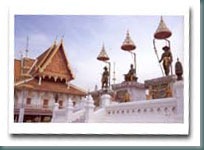
Today, there are but groups of crumbling ruins and rows of headless Buddhas where once an empire thrived. The temple compounds are still awe-inspiring even in disrepair and a visit here is memorable and a good beginning for those drawn to the relics of history.
The architecture of Ayutthaya is a fascinating mix of Khmer (ancient Cambodian style) and early Sukhothai style. Some cactus-shaped obelisks, called prangs, denote Khmer influence and look something like the famous towers of Angkor Wat. The more pointed stupas are ascribed to the Sukhothai influence. For new arrivals who had limited their visit to Bangkok, similarities may be noted with the riverside Wat Arun, an 18th-century structure that was built in the so-called Ayutthaya style, a melding of Sukhothai Buddhist influences and Hindu-inspired Khmer motifs.
Ayutthaya is administratively divided into 16 districts: Phra Nakhon Si Ayutthaya, Ban Phraek, Bang Ban, Bang Pahan, Bang Pa-in, Amphoe Bang Sai, Bang Sai, Lat Bua Luang, Maha Rat, Nakhon Luang, Phachi, Phak-Hai, Sena, Tha Rua, Uthai and Wang Noi.





